

Despite bipartisan support and polls showing Floridians overwhelmingly favor permanent daylight time, federal mandates like the 1966 Uniform Time Act keep us chained to twice-yearly clock changes
Sadly, Florida will not be able to opt out of this year’s “fall back” / “spring forward” BS time manipulation simply due to Senator Tom Cotton’s vote against the “Sunshine Protection Act.” Yes, the federal government claims jurisdiction over states when it comes to how states measure time. He argues this poses a serious risk to children walking to school or waiting for the bus in the pitch black. Regardless, the measure is extremely popular with Floridians. A recent Stetson University poll of over 1,000 nationally and found that more than 2-1 are in favor of ending the time clock changes twice a year. In 2018, the Florida legislature passed its own Sunshine Protection Act with overwhelming bipartisan support, which was signed by then-Governor Rick Scott.
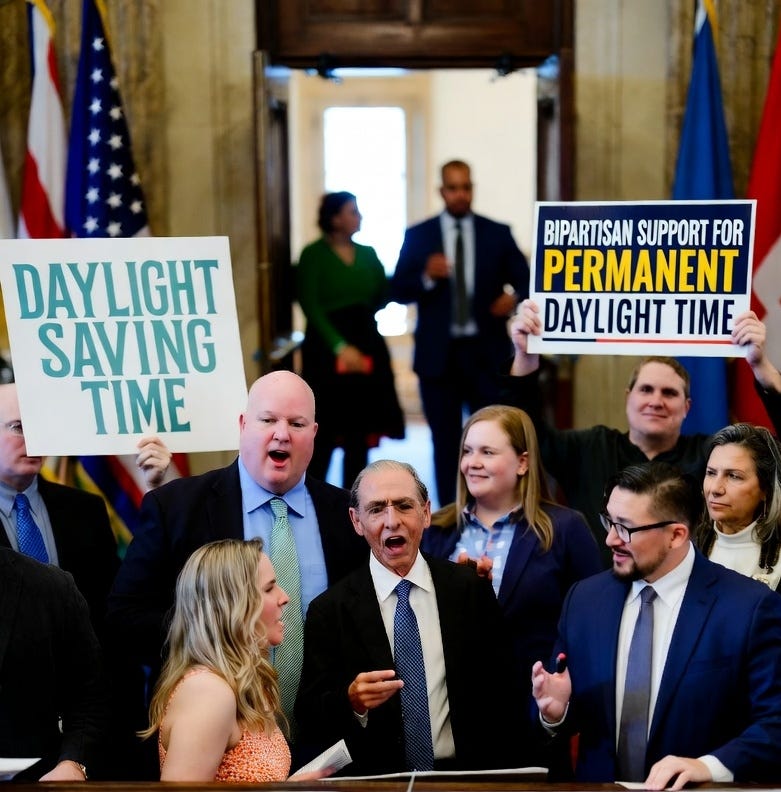
The 1966 Uniform Time Act is the central planning mandate by the federal government, granting itself dominion over Florida when it comes to time, even though other states have opted out. It dictates that every state must observe Daylight Saving Time unless its legislature passes a law to exempt itself. But—and this is the entire crux of the issue—the exemption is only in one direction. A state can only opt out of DST to remain on permanent Standard Time.
Arizona and Hawaii did that. They decided the twice-yearly change was disruptive and unnecessary (especially for Hawaii, being so close to the equator) and passed state laws to remain on Standard Time all year. The federal government permitted this. So, Florida could conceivably vote to not “spring forward” at all. This would put Florida on permanent Standard Time. The 1966 Act explicitly allows this. But the Florida legislature chose to do the opposite, which the Act does not allow—to put itself on permanent daylight savings time to get more sun in the evenings. I don’t think most Floridians know the difference in this part of the debate. So Florida could stop changing its clocks twice a year, if it did what Arizona did by prioritizing brighter mornings in the winter. The cost is that the sun sets early in the winter (around 5:30 PM in Florida) and in the summer (around 8:30 PM instead of 9:30 PM).
But that may not be as palatable from a tourism standpoint, which is why the Florida legislature rolled the dice trying for more sunshine in the evenings; or perhaps they knew the measure would never make it through Congress, appealing to voters’ desires, but knowing in the background it would never happen. Who knows.
So, we are back where we started in 2018 when Florida voters made their wishes known in no uncertain terms to their Florida reps. We’ll be changing our clocks “back an hour” this weekend, and back again this spring. Chained to the federal government’s whims, negating Florida’s 10th Amendment right. I would almost suggest that Florida sue the federal government to gain this 10th Amendment right to govern its own time, though it could be risky due to the Commerce Clause. Again, who knows?

Do you like this page?